Two things make me extremely happy: Sea Salt with Caramel Ribbons ice cream on a waffle cone from Salt & Straw in San Francisco and building Cute Desk App widgets.
No backlog refinement sessions. No stakeholder alignment meetings. No sprint planning negotiations over capacity. No dependency mapping across teams. No roadmap debates.
The user is me. The stakeholder is me. The builder is me.
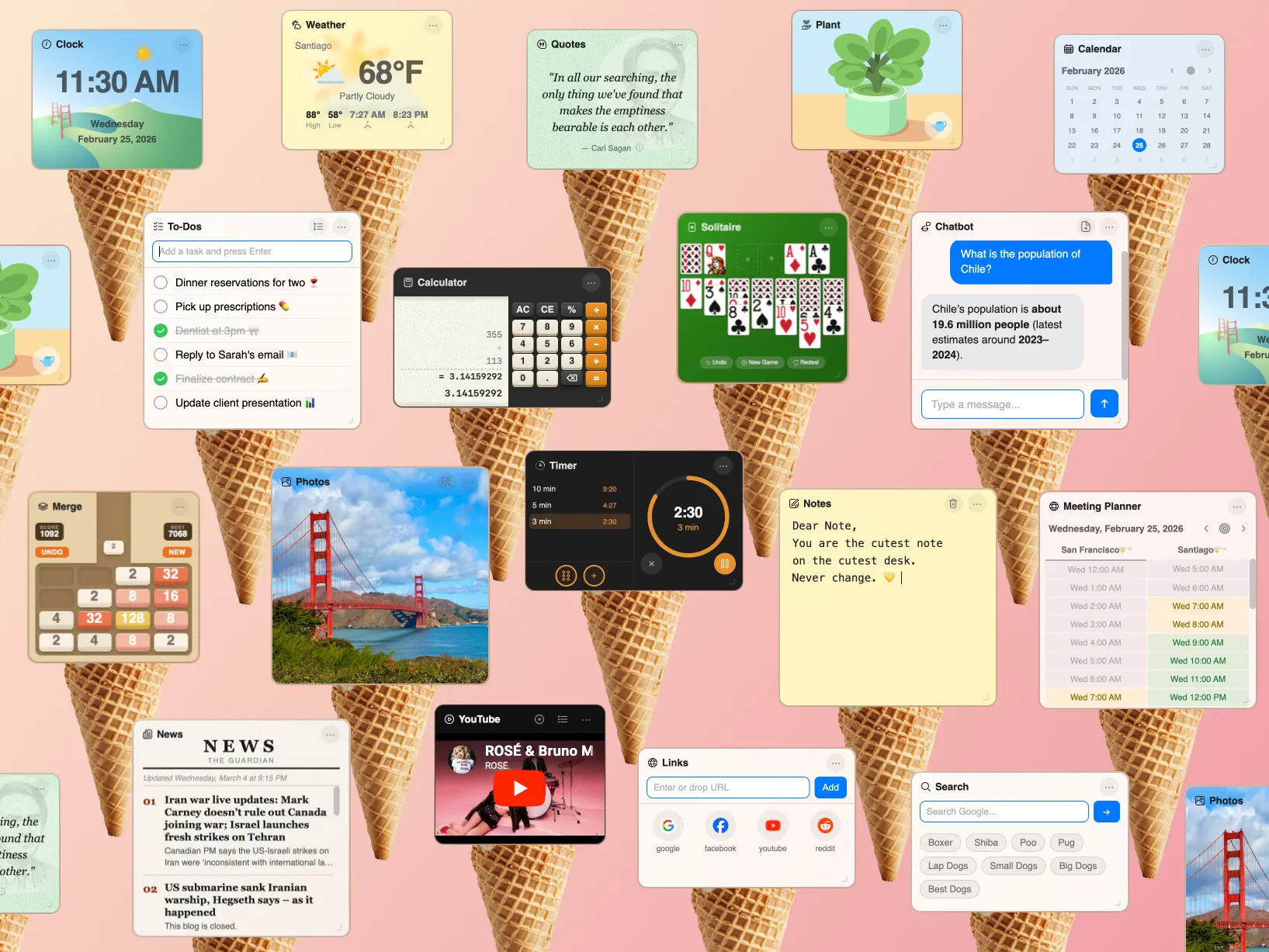
I'm building Cute Desk App, a browser start page (homepage) made of small, useful widgets. Each widget is a tiny app with one encapsulated purpose. A clock, a weather display, a note pad, a solitaire game, a cute virtual plant, and a dozen more widgets. Each widget is like an ice cream cone with its own flavor and joy.
And I'm having the best time of my life doing it.
Let me tell you why, and what it's taught me about the work we do as product leaders.
I Am the Customer
With Cute Desk App, there is no gap between me and the customer, because I am the customer.
I built the weather widget because I wanted to see the forecast every time I opened a new browser tab. I built the notes widget because I keep small scraps of text that don't belong in a full note-taking app. I built the 1970s paper roll calculator because the retro feeling of scrolling through past calculations was too cool not to build.
I know what I want, and I build it.
Product-market fit is instant when you are the market.
This sounds like a luxury, and it is.
So much of product management exists to bridge the distance between the people who build products and the people who use them. When that distance shrinks, you start to see what the work really looks like without the overhead.
When the distance between builder and user disappears, so does most of the process.
But it also reveals something important about discipline and constraints. Being the customer doesn't mean I can have everything I want. It means I feel every trade-off personally.
The Widget Model: Small Bets, Fast Joy
Most product work operates on long cycles. Weeks in discovery. Months in development. Quarters before you see real user feedback.
Cute Desk App gave me instant satisfaction. Each widget is like two scoops of purely delicious goodness on a waffle cone: small, self-contained, and satisfying from the first bite.
Every widget is contained, has one job, one clear purpose, and a small surface area. Most widgets' functionality seems familiar, with mental models that everyone already understands. A Pomodoro timer doesn't need to integrate with backend systems. It just needs to count down and notify you. That's it.
The commitment per widget is measured in days, not sprints. I go from idea to working feature to "I'm actually using this widget every day" in a short burst of focused effort. And because each widget ships as a complete, finished feature, I get the satisfaction of "done" multiple times a month.
The widget model also unlocks something I didn't expect: genuine creativity. When the scope is small and the stakes are personal, you give yourself permission to try things and be creative.
This is the same space that artists, painters, and sculptors create for themselves. They protect their creative process from outside influence, not because feedback has no value, but because the purest work comes from an unfiltered vision. In most product organizations, creativity gets shaped by consensus. By the time an idea survives stakeholder feedback, design reviews, and prioritization debates, the original spark has been sanded down. Building widgets gives me the artist's studio experience.
One vision, no committee, and the freedom to follow a creative impulse wherever it leads.
Different feelings drive different widgets: I built a virtual plant that you water daily, and if you don't, it dies. That was pure creative curiosity, but I wasn't thinking about retention metrics. I implemented a solitaire game card by card because of a passionate love of nostalgia for the old Windows Klondike Solitaire game, but I wasn't thinking about Daily Active Users. Creativity, nostalgia, utility, a retro aesthetic. Each widget has its own reason to exist.
None of these widgets would have survived a feature validation process. But it doesn't matter, because what really matters is that implementing each one makes me happy.
Everything I'm Not Doing (And Why I Know It Matters)
After 10+ years of product leadership at companies like Adobe and Autodesk, I know exactly what I'm choosing not to do with this project. And I want to be specific, because naming these things is the point.
No user research. No interviews, no personas, no journey maps. The research is me opening a new tab and noticing what's missing.
No validation cycles. No surveys, no A/B tests, no debating sample sizes. The validation is whether I keep the tab open.
No backlog refinement sessions. The backlog is a notes widget on my own start page. Total refinement time: about ten seconds.
No stakeholder alignment meetings. Nobody asks, "What's the business case for the inspirational quotes widget?" I love Carl Sagan's quotes from Cosmos and I wanted to see them often when I open a browser tab. That's the business case.
No sprint planning negotiations. My developer is an AI coding partner. My sprint is whatever I want to build that week.
No dependency mapping. The only system I depend on is my own.
No roadmap debates. If I wake up thinking that I need to have meetings with a client in a different time zone and I want to make sure the meeting time works for both of us, I'll create a meeting planner widget. And just like that, the meeting planner widget becomes the roadmap.
No responsibility without formal authority. Every PM knows this one. You own the outcome but don't control the resources. You influence, you persuade, you negotiate. On this project, I don't need to influence anyone. The decision is mine, the execution is mine, and the accountability is mine. For once, the authority matches the responsibility.
I'm not dismissing any of these practices. I use every single one of them with my consulting clients at Copotential. They exist because they solve real coordination problems at scale.
But when you remove all of that, you get to see the work underneath. And the work underneath is clearer than you'd expect: identify a need, write a focused PRD, build it with intention, use it, and improve it.
What This Reminded Me About Product Work
I started my career as an engineer. I remember the feeling of writing code that worked, deploying something real, and seeing people use it. That feeling got buried over the years under layers of process, politics, and organizational complexity. Not because those layers are bad, but because they accumulate.
Cute Desk App scraped those layers off and reminded me of something I'd half-forgotten: the craft of building a product is inherently joyful. Solving a real problem, even a small one. Making something that didn't exist before. Using it and thinking, "Yes, this is exactly what I wanted."
If you lead products for a living, find your own version of Cute Desk App. Build something small, just for you. Something that brings you the same joy as your favorite ice cream flavor on a sunny afternoon.
You might be surprised what it reminds you. 🛠️
Check it out and play with it: cutedesk.app

Aldo is a product leader with 10+ years of experience helping Fortune 500 companies, small businesses, and startups build and grow web, mobile, eCommerce, and AI integration in operations and digital products. He is the founder of Copotential, a San Francisco-based product consultancy.