
Most people I talk to about AI feel like they are running behind. The pace of news is relentless. New models, new tools, new frameworks every week. Every conversation begins with the same quiet question: am I already too late?
I have been telling them the same thing lately. It is 1914.
Let me explain what I mean.
Where AI actually is, by the numbers
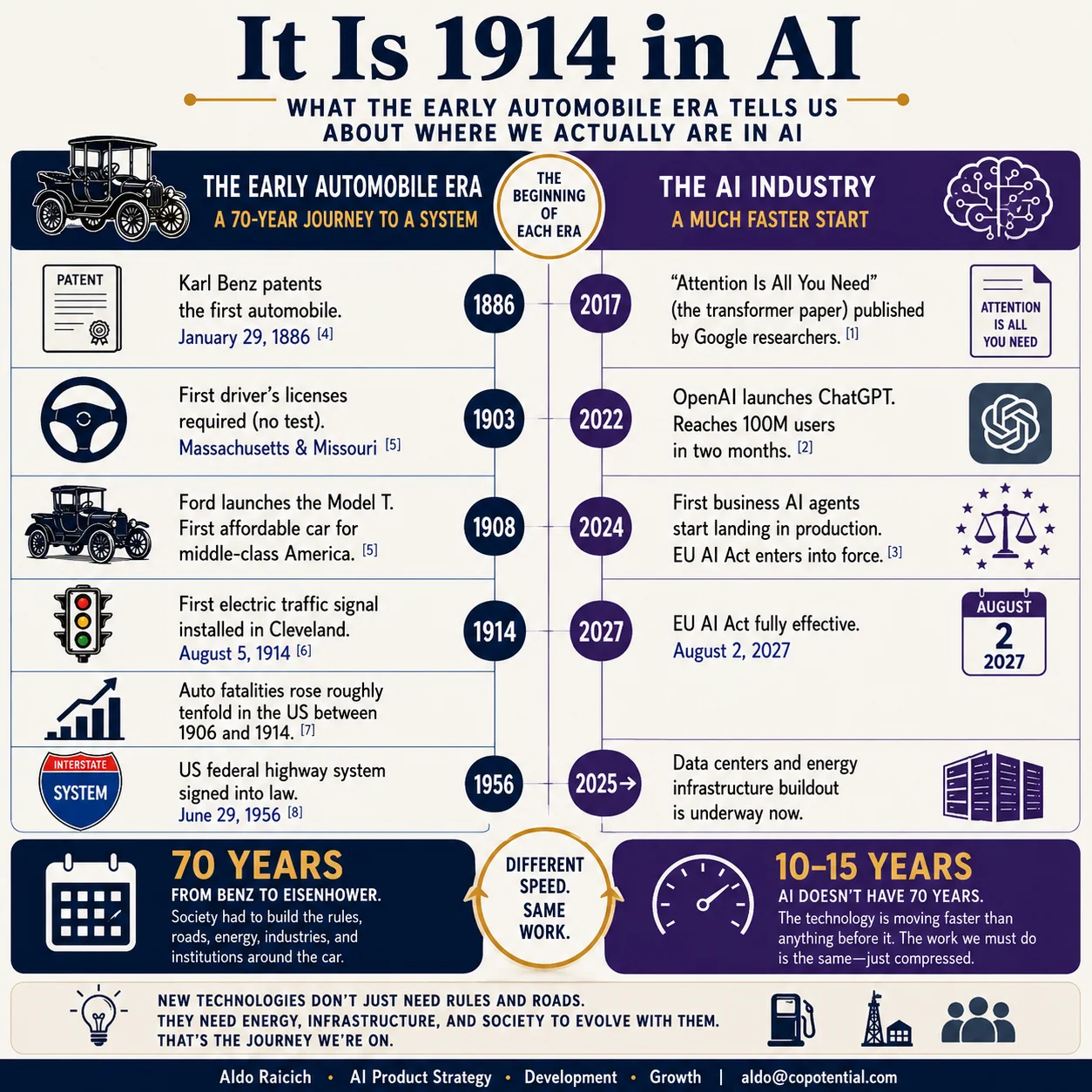
The transformer architecture that powers every major AI model today was introduced in a single paper called "Attention Is All You Need," published by Google researchers in 2017.1 That is nine years ago.
ChatGPT launched on November 30, 2022. It reached 100 million users in two months, which made it the fastest-growing consumer product in history.2 Most leaders I work with would place their first real interaction with AI somewhere between early 2023 and late 2024. That is roughly two to three years ago.
The first business agents started landing in production around 2024. The EU AI Act, the first comprehensive AI law anywhere in the world, entered into force on August 1, 2024.3 Its main rules will not be fully effective until August 2, 2027.
Right now, major companies are racing to build data centers across the United States and around the world. Most of that new capacity will go to training the next generation of models and running real-time inference for everyone using AI today. The compute infrastructure that AI runs on is being poured in concrete this year. Not in five years. Now.
So where are we, really? About nine years into the technology. About three years into deployment. About one year into serious regulation. The infrastructure is being built around us as we speak. That is the whole picture.
Now let me put a different timeline next to it.
The car timeline you may have forgotten
Karl Benz filed the patent for the first practical automobile on January 29, 1886.4 That is the day the car began.
For the next seventeen years, almost nothing happened around it that we would today recognize as a system. No driver's licenses. No traffic lights. No road rules. No insurance regimes. Cars were rare, dangerous, and largely unregulated.
By 1903, enough people had been killed or injured by automobiles that the first regulation arrived. Massachusetts and Missouri became the first states to require a driver's license.5 There was no test. You paid a fee and got a card. The goal at that point was not competence. It was that someone, somewhere, knew who was behind the wheel.
Five years later, in 1908, Henry Ford launched the Model T, the first affordable car for middle-class Americans. The same year, Rhode Island became the first state to require both a license and a road exam.
The first electric traffic signal was installed in Cleveland on August 5, 1914.6 Between 1906 and 1914, automobile fatalities had risen roughly tenfold.7 The traffic light arrived after the deaths, not before them.
1914 was a year of enormous optimism and enormous disruption at the same time. The traffic light went up the day after Britain entered World War I. The Panama Canal opened ten days later. The world was rearranging itself in ways most people could not yet see.
The federal interstate highway system was not signed into law until June 29, 1956, when US President Dwight D. Eisenhower signed the Federal-Aid Highway Act.8 That is seventy years after the first car.
And the highway system was only part of what the car required. The oil industry grew in parallel: refineries, pipelines, gas stations, tanker fleets. The geopolitics of the twentieth century, including much of what shaped the modern Middle East, would not look the way it does without the world's dependence on petroleum, which is mostly a story about the cars and trucks we built. New technologies do not just need rules and roads. They need an energy supply, and that energy supply reshapes the world around it.
Seventy years. That is how long it took for society to organize itself around the car. Seventy years from Benz to Eisenhower.
The car kept evolving after that, of course. Seatbelts, emissions standards, airbags, electric vehicles, self-driving cars. The story is still being written. But by 1956, the foundation was in place. The question had shifted from "what is this thing" to "how do we keep making it better."
AI does not have seventy years. It probably has ten or fifteen. The technology is moving faster than anything that came before it. But the work that has to be done, writing the laws, building the energy supply, training the people, learning to live with mistakes, is the same work. Just compressed.
The two timelines side by side
| Automobile | AI |
|---|---|
| 1886 Karl Benz patents the first car | 2017 "Attention Is All You Need" published |
| 1903 First driver's licenses required (no test) | |
| 1908 Ford launches the Model T | 2022 OpenAI launches ChatGPT |
| 1906–1914 Auto fatalities rise roughly tenfold in the US | |
| 1914 First electric traffic light installed in Cleveland | 2027 EU AI Act fully effective |
| 1956 US federal highway system signed into law | 2025–26 Data centers and energy buildout underway |
What this means for AI
If you map that timeline onto where AI actually is, we are not in 1956, the era of mature infrastructure and a federal highway system. We are roughly in 1914. The first traffic light has just been installed in Cleveland. Driver's licenses still do not require a test in most places. There are no highways. The Model T has been on the road for six years, but most people have still never driven a car.
The first AI traffic lights are just being installed. We do not yet have AI driver's licenses. We do not yet have the equivalent of the highway system.
This is not a critique. It is a map.
You are not behind. You are early.
There is a real difference. "Behind" implies that other people have figured it out and you have not. "Early" implies that nobody has figured it out yet, and the people who appear most confident are usually the ones who started paying attention six or twelve months before you did. In my conversations with founders, executives, and managers, almost everyone is in the same place. Some have a small head start. Almost no one has a head start of years, because those years do not exist yet.
The pace of AI is also nothing like the pace of the car. The car grew at the pace of human adoption. People had to learn to drive, roads had to be built, fuel had to be distributed. Each step took years. AI is growing on an exponential curve. New models that are meaningfully more capable than the last appear every few months. Adoption has reached hundreds of millions of weekly users in three years. We are compressing into a single decade what cars took roughly forty years to do. That is real. It is also true that we are still very early on the curve. Both can be held at once.
What this should change for you
If you accept the 1914 framing, a few things follow naturally.
You do not need to know everything. Nobody does. The leaders who appear confident in AI right now are confident because they have been paying attention for a year or two, not because they have mastered something. Mastery does not exist yet.
You do not need to bet on a specific tool. The Model T was not the first car. By the time Ford launched it, dozens of car manufacturers were competing for the same buyer. Cadillac, Buick, Oldsmobile, Studebaker, Packard, and many more. A few of those survived. Most are forgotten. The same is true of the AI products and platforms competing today. Most of the names you hear this year will not be the names that matter ten years from now. Picking a single vendor in 1914 was a mistake. Picking a posture in 1914 was the right move.
You should still move, gently. The cost of moving thoughtfully now is small. A few hours of conversation. A small pilot. A written assessment of where AI fits in your operations. The cost of waiting until things are settled is real, because by the time they are settled the competitive ground will have shifted underneath the people who waited.
You should expect mistakes. Cars killed people for decades before traffic lights existed. AI is going to produce real harms before the right guardrails exist around it. This is what early always looks like. The right response is not to refuse to use the technology. It is to use it with care, in the right places, with appropriate human oversight.
A note on emotional ground
If you have been feeling overwhelmed by AI, the 1914 framing is meant to do one thing for you. It is meant to give you back time.
The pace of news will not slow down. The model releases will keep coming. The tools will keep changing. None of that means you have to keep up at the pace of the news. You need to keep up at the pace of your own business, which moves on a different clock.
The owner of a clinic in 1914 did not need to understand internal combustion engineering. They needed to understand what a horseless carriage meant for their patients, their staff, and their day. The same is true for you now. You do not need to understand transformer architecture. You need to understand what AI means for your customers, your team, and your work.
That is a calmer question. It is also the right one.
If you would like to talk through where AI fits in your operations, no hype and no overwhelm, I am happy to sit with you.

Aldo is a senior product leader and hands-on AI coach. He has spent two decades shipping products at companies like Adobe, Autodesk, and Visa. Today he helps businesses where technology isn't the main product adopt AI in the way they actually work. He is the founder of Copotential, based in San Francisco.
References
1 Vaswani et al., "Attention Is All You Need," Google Research, 2017.
2 OpenAI, ChatGPT research preview release, November 30, 2022. Reuters reporting on 100 million users milestone, February 2023.
3 Regulation (EU) 2024/1689, European Union AI Act, entered into force August 1, 2024.
4 Mercedes-Benz Group, "Benz Patent Motor Car: The first automobile (1885 to 1886)."
5 History.com, "When was the first U.S. driver's license issued?"
6 Cleveland Police Museum, "Early Electric Traffic Signals in Cleveland."
7 Dittrick Medical History Center, Case Western Reserve University, "Touch and Go: Cars, Health and Cleveland's First Traffic Signals," citing US Census Bureau mortality data.
8 National Archives, "National Interstate and Defense Highways Act (1956)."