
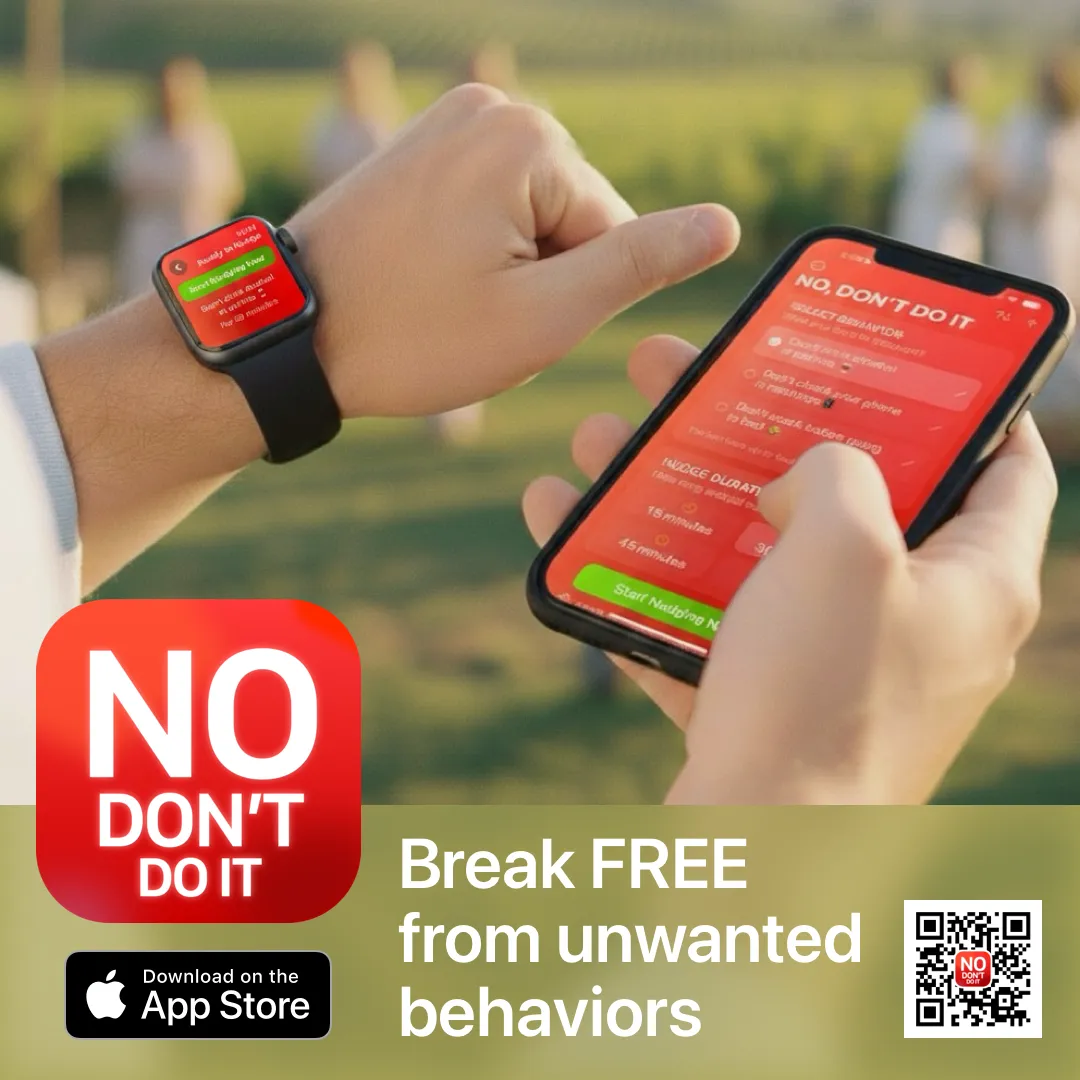
When I moved to Sonoma wine country two years ago from San Francisco, I discovered something that would become the foundation for an entirely new approach to habit intervention apps—behavior interruption. As the founder of Digiguys Apps, I led the development of the "No, Don't Do It" app while applying the product management principles I use in my consulting practice at Copotential.
This case study explores how my team and I created the app from a personal pain point into a launched product, applying rigorous product management principles across the discovery, development, and growth phases.
Product Discovery – Turning Personal Insight into Market Opportunity
The Initial Observation
Living in wine country meant every social gathering included wine—excellent wine, and plenty of it. I realized I had apps to track my calories, steps, sleep, and meditation streaks, but nothing that would actually intervene in the moment when someone's pouring another glass of wine—no little voice saying, "Hey, remember what you decided earlier?"
Strategic Framework Development
As a product leader, I knew personal frustration alone doesn't validate a market opportunity. I structured our discovery phase around three key questions:
- Market Size: How many people struggle with situational behavior triggers?
- Competitive Landscape: Why haven't existing solutions solved this problem?
- Technical Feasibility: Can we deliver real-time intervention effectively?
Research-Driven Validation
Instead of rushing to build, I invested weeks in behavioral psychology research. This wasn't an academic exercise—it was strategic product planning. Three findings shaped our entire approach:
Wood & Neal's Habit Loop Research (2007): Revealed that habits are automatic responses to environmental cues, but there's a brief intervention window before automaticity takes over. This validated our core hypothesis.
Nahum-Shani's JITAI Studies: Proved that Just-in-Time Adaptive Interventions delivered during vulnerability states are 40% more effective than general reminders. This became our key differentiator.
University of Washington Haptic Research: Demonstrated that tactile feedback bypasses notification blindness. This informed our core interaction model.
Positioning Strategy
Based on our research, I developed a clear positioning statement that would guide everything from development to marketing:
People need gentle nudging to interrupt unwanted behaviors during triggering situations before they start.
This positioning deliberately contrasts with every habit tracker in the market. We weren't building another analytics dashboard. Instead, we were creating a real-time behavior intervention system.
User Persona Development
Our research identified three primary personas:
- Situational Strugglers: People who do well generally but fail in specific contexts (parties, meetings, stores)
- Professional Maintainers: Executives and professionals needing discrete behavioral support
- Health-Adjacent Users: People with therapist/doctor support seeking complementary tools
Each persona influenced different aspects of our product strategy, from feature prioritization to pricing model.
Product Development – From Concept to Technical Reality
The Simplicity Principle
Throughout development, we maintained a strict simplicity principle. Setup takes less than 30 seconds:
- Open the app when entering the triggering situation
- Select behavior to avoid
- Choose duration for haptic vibrations
- Start session
No accounts, no complex configuration, no social features. Every additional feature request was evaluated against this simplicity standard. Users could start haptic nudging sessions directly from either their iPhone or Apple Watch.
The Apple Watch Challenge
We needed to deliver discreet, private nudges to make users aware of unwanted behaviors. iOS notifications were too disruptive and required user interaction. We wanted gentle, discreet nudging—and Apple Watch and iPhone haptic vibrations delivered exactly that: silent, private nudges on the user's wrist or in their pocket.
Haptic vibrations delivered the gentle, private, and discreet nudging that we need to interrupt an unwanted behavior.
When my long-time technical collaborator Vitalii and I began development, we immediately hit Apple's ecosystem constraints. The Apple Watch's haptic vibrations needed to run continuously for extended periods, which exposed significant battery usage limitations.
Instead of viewing this as a limitation, we embraced the constraint. It compelled us to gain a deep understanding of the Apple ecosystem, align with Apple's app review requirements, and deliver laser-focused features.
Technical Architecture Decisions
Working with Apple's ecosystem required several critical technical decisions:
Synchronization Strategy: We implemented a dual-device approach. The iPhone's larger screen handles setup and configuration, while the Apple Watch delivers haptic intervention.
Haptic Pattern Design: We tested dozens of vibration patterns before landing on Morse code for "NO" (dash-dot, dash-dash-dash). It's distinctive enough from other haptics.
Battery Optimization: Through iterative testing, we found the optimal balance between haptic vibration nudging frequency and battery consumption. Critical for Apple app review approval.
Fallback Systems: We built iPhone haptic vibration delivery as a primary feature, not a fallback, recognizing that not all users have Apple Watches.
Product Growth – Scaling Through Strategic Channel Development
App Store Optimization (ASO)
Our App Store strategy focused on three elements:
Keyword Optimization: We identified that users search for problems ("stop drinking at parties") rather than solutions ("habit tracker"). Our keyword strategy reflected this insight.
Visual Storytelling: Screenshots show the app in context, at a party, in a meeting, while shopping, rather than just UI screens. This immediately communicates use cases.
Description Structure: We lead with the problem, not features. The first line addresses pain points before explaining our solution.
Freemium Model Evolution
Our monetization strategy evolved through testing:
First iteration: 5-minute daily limit. This was too restrictive and frustrated users in actual triggering situations.
Second iteration: Unlimited 5-minute sessions are free, followed by paid 30-minute, 45-minute, and 60-minute sessions.
Pricing Model: We offer lower-cost subscription plans, along with a one-time lifetime purchase option, to cater to users who dislike subscriptions.
Mixing lifetime purchases with subscriptions means MRR doesn't capture the whole picture. We focus on ARPU and ARPPU instead, amortizing one-time payments over expected customer lifetime.
The freemium model serves as both an acquisition strategy and a product validation—users can verify value before paying.
Organic Social Media Strategy
We developed a rotating weekly content theme:
- Week 1: Drinking/Alcohol
- Week 2: Vaping/Smoking
- Week 3: Overeating/Snacking
- Week 4: Phone/Screen addiction
Each week includes:
- Monday–Wednesday: Content creation (9:16 video with captions, 1080x1080 image)
- Thursday: Cross-platform organic posting (Facebook page, Facebook personal account, Instagram Reels, YouTube Shorts, TikTok, LinkedIn, Twitter/X)
- Friday–Sunday: Community engagement and response (Likes/Hearts and comments)
This systematic approach ensures a consistent presence on social without overwhelming our audience.
Paid Acquisition Channels
We're testing three paid channels with distinct strategies:
Apple Search Ads: Targeting high-intent searches with exact match keywords around specific behaviors and situations. Budget: majority of our paid spend.
Meta Ads (Facebook/Instagram): Video-first creative showing the app in social situations where people need intervention. Targeting interests related to wellness, mindfulness, and self-improvement. Budget: smaller portion of paid spend.
Growth Metrics and Learning
While it's early to share definitive metrics, we're carefully tracking key indicators like free-to-paid conversion rates and weekly active user retention.
Initial patterns show that users who discover us through specific behavior searches ("stop stress eating meetings") convert at significantly higher rates than general wellness seekers.
Key Takeaways for Product Leaders
On Discovery
- Personal pain points can reveal market gaps, but validate with research
- Behavioral science provides defensible differentiation in crowded markets
- Clear positioning must contrast, not compare with existing solutions
On Development
- Simplicity requires discipline—every feature must earn its complexity
- Technical constraints often improve products by forcing focus
- Platform limitations can become product advantages with proper framing
On Growth
- Problem-aware users convert better than solution-aware users
- Systematic content strategies scale better than sporadic brilliance
- Monetization models must respect users, as some hate subscriptions
The Product Leader's Perspective
Building the "No, Don't Do It" app reinforced a critical lesson: the best products emerge from genuine problems, rigorous research, and disciplined execution. We didn't try to build a platform or chase trendy features. We solved one problem exceptionally well.
For companies considering their next product initiative or product managers developing their skills, this case study demonstrates that innovation doesn't require complexity. Sometimes the most powerful products are the simplest—they just need to intervene at exactly the right moment.
The journey from wine country realization to App Store launch took dozens of iterations and countless hours of research. But the core insight remained constant: people don't need another app to track their failures; they need help preventing them in the first place with discreet haptic interruption.
Learn more about the No, Don't Do It app on the Digiguys Apps product page.



Aldo is a product leader with 10+ years of experience helping Fortune 500 companies, small businesses, and startups build and grow web, mobile, eCommerce, and AI integration in operations and digital products. He is the founder of Copotential, a San Francisco-based product consultancy.